Reports
August 26, 2026

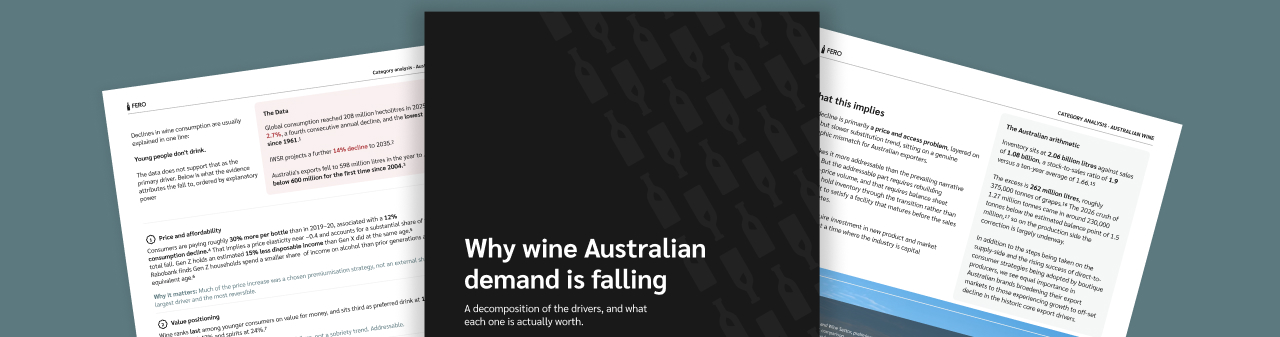
Why Australian wine demand is falling: A category report

Fero's category report on the Australian wine decline: five drivers ranked by explanatory power, and why the explanation the industry has settled on ranks last of the five.

"Gen Z doesn't drink."

It is the line you hear in every tasting room, at every trade tasting, in most conversations about where Australian wine went. It is also the explanation that holds up worst under scrutiny.

On a recent road trip through the Hunter, Barossa, McLaren Vale and Adelaide Hills, Fero's Head of Commercial for Australia, Lauren Thompson, and CEO Mitch Fowler heard the same diagnosis from producer after producer. Make no mistake, the situation is difficult: Australian wine exports fell below 600 million litres in the year to June 2026, the first time in over two decades. Global consumption is at its lowest level since 1961.

But when we went looking for the evidence behind the generational explanation, the numbers pointed somewhere else.

This report decomposes the decline into five drivers, ranked by how much of the fall each one actually explains:

  • What a 30% rise in bottle price has done to volume, and why that was a choice rather than a shock
  • Where wine now sits against beer and spirits on value for money among younger drinkers
  • The geographic mismatch between Australia's export book and the markets that are still growing
  • What RTDs taking one point of global alcohol share actually costs the wine category in hectolitres
  • What Gen Z participation data genuinely shows, and why selectivity is not the same thing as abstinence

Plus the Australian arithmetic: 2.06 billion litres of inventory against 1.08 billion litres of sales, and what the 2026 crush tells us about how far the correction has already gone.

The conclusion matters more than the diagnosis. If the decline is primarily a price and access problem, it is considerably more addressable than the prevailing narrative suggests. But addressing it requires holding inventory through a transition rather than liquidating it, and that is a balance sheet question.

Enter your details below to read the full report.

Unlock this content

Enter your details and it's yours — instantly, right on this page.
Thank you! Your submission has been received!
Oops! Something went wrong while submitting the form.
Download the Report

About this report

In a recent road trip to some of Australia's premier wine regions, including the Hunter, Barossa, McLaren Vale and Adelaide Hills, Fero's Head of Commercial for Australia, Lauren Thompson, and CEO Mitch Fowler heard first-hand about the challenges facing the Australian wine industry.

Make no mistake: it is challenging. Australian wine exports fell just below 600 million litres for the first time in over two decades. The instinctive explanation, a generation turning its back on wine, is the one several producers are congregating around.

This report tests that explanation against the available evidence. It decomposes the category decline into five drivers, ranked by explanatory power, and separates what producers can influence from what they cannot.

What the report finds

The decline is primarily a price and access problem, layered on a real but slower substitution trend, sitting on a genuine geographic mismatch for Australian exporters. Generational abstinence ranks last of the five drivers. Gen Z participation is stable year on year and higher than in 2023; what has changed is the number of categories consumed per occasion, which points to selectivity rather than abstention. The genuine structural signal is engagement: in the UK, 26% of regular wine drinkers are aged 18 to 39 against 48% aged 55 and over, down from 36% in 2010.

That reframing matters commercially. A positioning and pricing problem is addressable. A generational one is not.

A note on method

The weightings in this report are an assessed reading of the available evidence, not a formal statistical decomposition. No published variance decomposition of the category decline exists. Several consumer datasets draw on US and UK research, as no equivalent Australian generational participation dataset is currently available. Sources are listed in full in the report.

Talk it through

Fero provides capital against inventories and receivables, global market access and route-to-market automation. If you would like to discuss what that looks like for your brand, contact Lauren Thompson, Head of Commercial for Australia, at lauren.thompson@ferodrinks.com.

Download the Report