14 trends expected to shape global spirits over the next 18 months
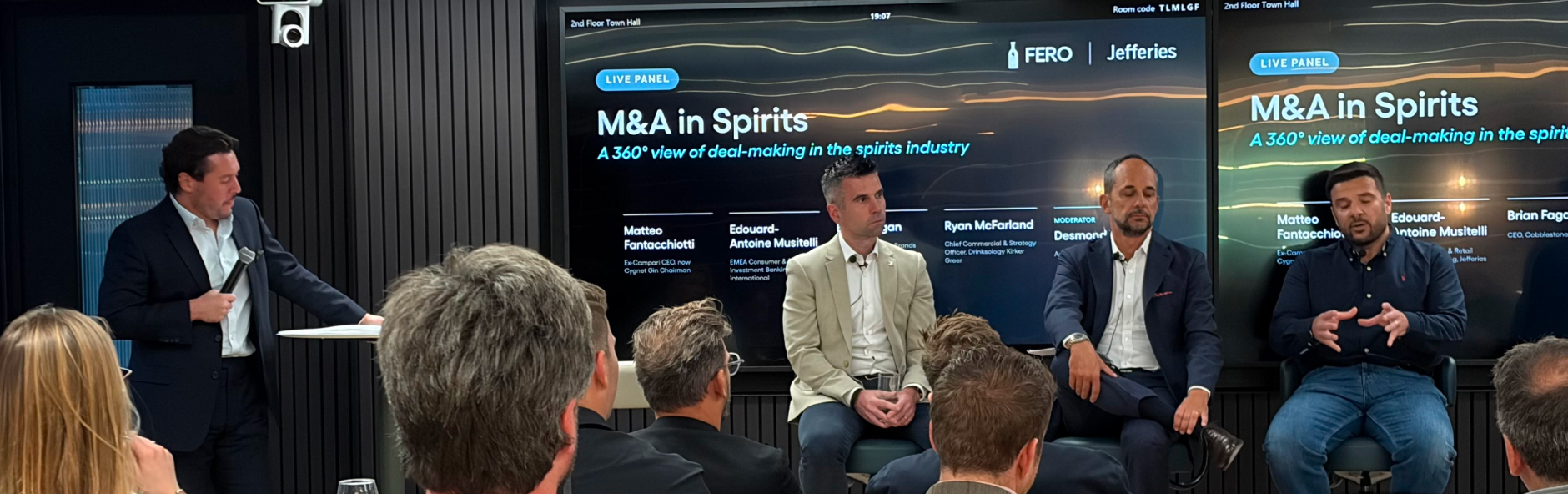
Less than two weeks ago senior leaders across the global spirits industry gathered for a closed door session at Fero HQ to hear about significant trends they expect to see across the sector over the next 18 months.
The panel discussion, moderated by Desmond Woods, from Fero, and co-hosted with Jefferies, covered a range of topics. The panelist included Matteo Fantacchiotti, ex-Campari CEO and Cygnet Gin Chairman, Edouard-Antoine Musitelli, EMEA consumer & retail investment banking from Jefferies, Brian Fagan, CEO of Cobblestone Brands and Ryan McFarland, Chief Commercial & strategy Officer, Drinksology Kirker Greer.
The panel covered a range of topics including the market backdrop, why some of the biggest drinks companies are buying and selling right now, what those acquiring are looking for and what actually helps a deal close.
Unlock this content
Enter your details and it's yours — instantly, right on this page.
Thank you! Your submission has been received!
Oops! Something went wrong while submitting the form.
The market backdrop
1. The cycle is bottoming out, but recovery will be uneven, not universal The panel was clear the post-COVID "super-cycle" hangover, including inventory overhang, destocking, disinflation, is stabilising. Several of the largest drinks companies are signalling improvement from next year. But it won't land evenly: some categories, geographies and price points will recover well before others. Expect continued caution on broad-brush growth assumptions.
2. Polarisation between value/convenience and authentic premium will continue, and the "inflated middle" will get punished Two things are working: cheap convenience formats like smaller packs, RTDs, grab-and-go and genuinely differentiated premium at honest price points. What's failing is inflated premiumisation with average liquid behind it. The tequila category was a cited example, where brands that pushed price without substance have struggled, while additive-free tequilas in the $25–35 range are thriving.
3. Gen Z drink differently, not less, but most majors are still reactive, not proactive Category penetration among Gen Z is actually high; what's changed is format, channel and spend per occasion. With this group earlier in their careers and less disposable income, that is not a surprise. The panel was candid that big companies' Gen Z strategy is largely reactive. They are waiting to see what works with often smaller, more experimental brands or accidental viral hits and then acquire them, rather than innovating for that audience directly.
4. Tariffs and geopolitics are ending the "one global playbook" era Multiple panellists pointed to tariffs and trade friction pushing big players toward regional production and localised route-to-market rather than a single global supply chain per brand. India came up repeatedly as a market of huge interest but real complexity. Genuine local partnerships, not straight brand export, is increasingly seen as the only workable model.
How and why acquisition is on the rise
5. M&A is increasingly about buying growth and scale, not funding innovation There was broad agreement that the bigger players are doubling down on core brands and extending existing IP rather than building genuinely new propositions internally. Real innovation still comes from smaller, agile players, which then larger players acquire the growth once it's proven, rather than generating it themselves.
6. M&A is partly financial engineering, not just strategy Buying an already-growing brand converts organic investment into inorganic growth that sits in goodwill/intangibles rather than hitting the P&L as an expense. This was described candidly as "a fabulous trick financially" for protecting top-line and EBIT. Worth remembering as a driver alongside the more obvious "filling portfolio gaps" narrative.
7. Multi-beverage strategy is a stated ambition industry-wide, but conviction is mixed Beer, spirits and soft drinks leading companies are all talking about "24/7 beverage solutions" and combined sales forces. This is partly genuine synergies, partly a way to spread the cost of an expensive route-to-market. But one panellist who'd worked across beer and spirits pushed back hard: shared consumption occasions don't necessarily translate to shared purchase behaviour or brand-building logic, and he was openly skeptical the strategy delivers as cleanly as some decks suggest.
What it takes to become acquirable
8. There are known financial thresholds brands should target if they want to be acquired Specifically one panelist clearly said to aim for a gross margin close to what a leading company's portfolio already averages. Even more specifically the high bar was to shoot for roughly 60% as a "north star". This ensures that cost synergies alone won't be the acquirer's main incentive, but not so far off that you look unfixable. Also noted buyers largely ignore overheads, as they'll strip them out anyway, so there's little point over-optimising that line for a pre-sale.
9. "Keep it simple" is the ideal, but few actually manage it One SKU, one brand, one liquid was described as the "golden ticket" for a clean acquisition. In practice, several panelists admitted their own portfolios are more complex than that, often for good commercial reasons including channel access and price architecture. But expect an acquirer to prune it back down post-deal regardless.
10. The bar for independent scale-up is higher than it was five to 10 years ago, with depth beating breadth Panellists agreed that a "cool new brand with zero volume" gets a much harder hearing from distributors today than it did a decade ago. The winning strategy now is proving real, deep consumer traction in one or two markets and not superficial presence in 35. That's what gives a potential acquirer confidence the model will scale.
11. US market entry is a high-stakes, high-cost decision, and there’s no clear cut answer on how to do it Several speakers flagged the US as both the biggest exit pathway and one of the most expensive, complex markets to enter credibly. The more convincing approach floated wasn't a broad national push but hyper-localised, almost neighbourhood-level focus in a handful of states. Brands need to build a repeatable playbook in three states, then use that proof point to make expansion, and the eventual acquisition conversation, an easier sell.
12. Being "exit-ready" is a discipline, not an event A smaller but pointed observation: founders who'd quietly kept their business acquisition-ready on an ongoing basis rather than only sprinting to prepare once a process started seem to always fare better. A live sale process is all-consuming and operational performance can slip right when you most need it to hold steady.
Where deals actually succeed or fail
13. Integration, and not the deal itself, is where value is won or lost This was one of the most candid threads: back-end integration including ERP systems, route-to-market, new codes/labels and supply chain, can routinely stall acquired brands for 12–18 months post-close, even with sophisticated buyers. One panellist described a team resorting to buying stock on a personal credit card because internal systems couldn't get product to market. Buyers who underestimate this can lose both momentum and the acquired team's original commercial focus.
14. Marketing spend is becoming more scientific, "sufficiency" over broad reach One panelist described the concept of "sufficiency": working out the actual media threshold needed to reach a target audience at an effective frequency, then checking honestly whether current investment clears that bar. In one internal review, even the number-one brand didn't clear the bar. The response from larger companies is to concentrate spend on fewer, bigger brands rather than spreading it thin across loads of brands. Plus there seem to be a general shift from above-the-line/agency spend, towards working with media and focusing on point-of-sale activation in a market.
The global spirits industry is still in the midst of fundamental change. While the panel agreed that stabilisation is on the distant horizon, those that can adapt to these changes fastest will be best poised to make the most of the opportunities such changes often unearth.
Thirsty for more?
Speak with our team of industry experts to see how Fero can bolster your business.